

The Reality Behind the Numbers
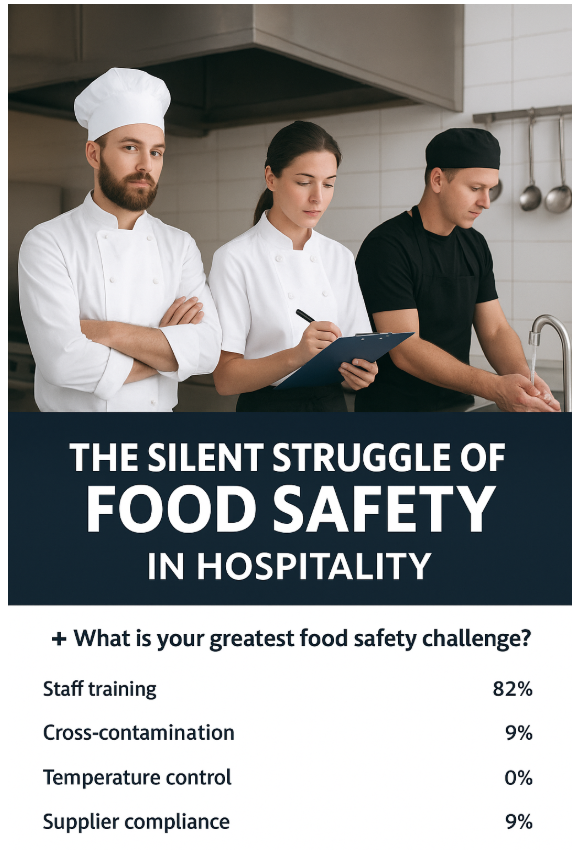
In our recent poll, we asked hospitality professionals: “What is your greatest food safety challenge?” The results were striking: 82% pointed to staff training as their biggest concern. Meanwhile, cross-contamination and supplier compliance tied at 9%, and surprisingly, temperature control received no votes.
What makes these insights even more valuable is that their diversity participants came from across the globe, including Ghana, Lebanon, Saudi Arabia, Vietnam, and beyond. This highlights that food safety challenges are not confined to one region but represent a shared struggle across the international hospitality industry.
Why Training Stands Out
Food safety is not just about equipment, processes, or policies; it is about people. Staff training remains the foundation of every safe kitchen, yet it is also the area most vulnerable to inconsistency. Employees may come from diverse backgrounds, with different levels of experience and understanding of hygiene standards. Without constant training and refreshers, even the most sophisticated safety systems can fail.
Comparisons with Academic Research
To put our poll in perspective, a recent study conducted in Saudi Arabia among restaurant food handlers found that, while awareness of food safety practices was generally high, practical application and consistent training were often lacking. The research, published in the Saudi Journal of Biological Sciences (2022), revealed that many workers could identify hygiene rules but struggled to apply them under pressure or during peak hours.
The study concluded that ongoing education and hands-on training are critical to ensuring food safety compliance reinforcing what our poll revealed: that training remains the most pressing challenge facing the hospitality sector today.
Beyond the Checklist
Many assume food safety can be reduced to a checklist: wash hands, check temperatures, sanitize surfaces. But hospitality professionals know it runs deeper. Training means shaping behaviors, building awareness, and cultivating a culture where safety is second nature. It requires time, patience, and, above all, consistency.
The Hidden Risks
The fact that temperature control received 0% of the votes is telling. It suggests that while technology and monitoring systems help manage these risks, the true challenge lies in human action. A supplier can comply, and a fridge can monitor itself but if staff are not adequately trained, contamination risks multiply.
A Call for Continuous Education
The poll highlights a truth many leaders in hospitality already know: investing in training is investing in safety. Beyond onboarding, businesses need continuous education, simulations, and practical refreshers. Food safety is not a one-time lesson, it is a daily practice.
Final Thought
Hospitality thrives on trust. Guests rarely think about food safety when enjoying a meal but behind every plate served is a team working to protect that trust. The results of our poll remind us that training isn’t just a technical challenge; it is a cultural one.